
Watershape Design Observations
- Quiet Ink
- Dec 13, 2025
- 5 min read
Updated: Jan 2
From Building Pools, Spas, Ponds, Lakes, and Fountains
Water has followed my work for most of my career—across residential gardens, commercial pools, ponds, fountains, and lakes—sometimes as architecture, sometimes as landscape, and often as infrastructure.

I began designing and building residential pools and spas at a time when watershapes were judged less by imagery and more by how they performed once people moved in. Later, that work expanded into ponds, fountains, and lake systems, where gravity, sound, edge conditions, and long-term maintenance mattered as much as form. Still later, my role shifted again—into large-scale, non-profit and senior living development—where water was no longer about novelty or indulgence, but about durability, accessibility, safety, and how environments age alongside the people who use them.
Seen across that arc, one lesson remains consistent: water is never neutral. It shapes movement, behavior, perception, and long-term satisfaction in ways few other landscape elements can. The observations that follow are not a catalogue of features. They are patterns—drawn from designing, building, maintaining, and overseeing water across very different contexts—about what endures, what adapts, and what quietly falls out of alignment over time.
Water as a Design Instrument
Water should be treated as a primary design decision, not an amenity added late in the process. Once introduced, it becomes a dominant spatial and experiential force. It controls sound, temperature, reflection, movement, and focus. Because of this, the success of a watershape depends far more on clarity of intent than on budget, technology, or finish.
Across residential, commercial, and institutional work, watershapes consistently fall into three primary categories:
Active Pools
Inactive Pools (including Fountain Pools)
Natural Water Systems — natural pools, ponds, waterfalls, creeks, and lakes
Waterfalls, notably, are not a category. They are elements that reinforce intent and can belong to any of the above.
Historical Context That Still Shapes Expectations

Modern expectations around pools and water features are layered with precedent:
Early estate pools functioned as architectural and symbolic devices—formal, axial, and often raised.
Mid-century residential pools emphasized leisure, informality, and indoor–outdoor living, particularly in California.
Later decades introduced recreation and spectacle, prioritizing activity and novelty.
Contemporary work often returns to restraint, treating water as space rather than program.
Natural water systems—ponds, streams, cascades—predate all of these traditions and have re-emerged where experience matters more than use.
Clients rarely articulate these influences, but they respond to them instinctively. Good design recognizes this lineage and applies it deliberately.

Active Pool — Primary
An Active Pool is designed for physical engagement. Its success is measured by how often and how long people are in the water.
Design Characteristics
Encourages movement, play, and social interaction
Accepts visual energy and complexity
Prioritizes safety, durability, and intuitive circulation
Typical Elements
Waterslides
Diving ledges or jump features
Laminar jets used for play or movement
Waterfalls designed for interaction, sound, or tactile experience
What Ages Well
Simplistic active pools perform best when they are honest about their role. Pools designed unapologetically for families and frequent use tend to remain satisfying, even as aesthetics soften or planting matures. Clear shallow zones, durable finishes, and legible circulation age better than hybrid designs that attempt to double as architectural statements.
The issue is not activity. It is confusion.

Inactive Pool — Primary
Including Fountain Pools
An Inactive Pool is designed primarily as a visual and spatial device. Swimming may occur, but it is not the defining purpose.
Design Characteristics
Strong geometry aligned with architecture
Disciplined edges and restrained detailing
Designed to be viewed from interior rooms and outdoor spaces
Typical Elements
Formal rectilinear or axial pool shapes
Fountain pools and water courts
Laminar jets used as compositional accents
Reflective surfaces extending views and space
Waterfalls used as visual or acoustic backdrops
What Ages Well
Inactive pools, often called "adult pools", behave like architecture. Their value lies in proportion, alignment, and restraint. Because they do not rely on novelty or demographic specificity, they adapt well to changes in ownership and lifestyle. From a construction standpoint, they are also easier to maintain and reinterpret without undermining original intent.


Waterfalls as Cross-Category Elements
Waterfalls do not define intent; they reinforce it.
In Active Pools, waterfalls invite interaction and sound
In Inactive Pools, waterfalls act as visual or acoustic backdrops
In Natural Systems, waterfalls express gravity, topography, and narrative
Design—not presence—determines their success.
Natural Water Systems — Primary
Natural Pools, Ponds, Waterfalls, Creeks, and Lakes
Natural water systems are not softened pools. They are landscape infrastructure whose value lies in presence, ecology, and sensory experience rather than program.
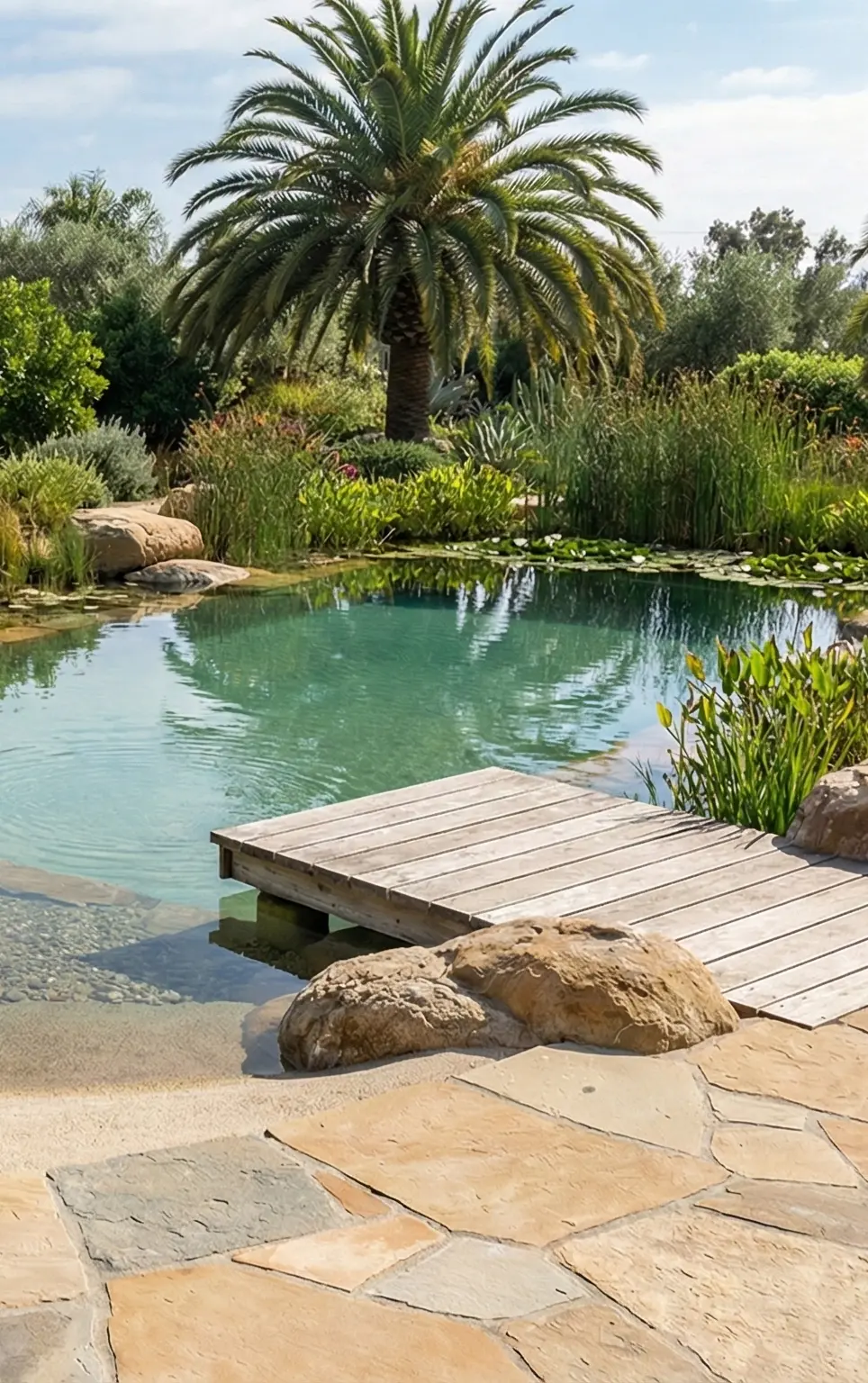
Design Characteristics
Integrated into the landscape rather than the house
Still or slow-moving water
Organic or formally natural geometry
Edges designed for planting, immersion, and seasonal change
Water movement driven by gravity and grade
Typical Elements
Natural swimming ponds
Reflective or habitat ponds
Waterfalls and cascades
Creeks, rills, and lakes
What Ages Well
Natural water that responds directly to landform and planting matures rather than dates. Over time, edges soften, vegetation establishes, and the system becomes more convincing. These watershapes tend to feel inevitable, not installed, and carry broad appeal across cultures and ownership cycles.

What Ages Poorly (Observed Over Time)
Certain patterns consistently erode satisfaction:
Features layered without hierarchy
Novelty-driven elements tied to fashion
Over-programmed designs that resist adaptation
These watershapes often function mechanically but lose emotional relevance. Over time, they begin to feel overdetermined.

Perspective From Commercial and Institutional Work

Commercial pools, fountains, ponds, and lake systems introduce a different level of scrutiny. Public use, regulatory oversight, safety, and long-term operations quickly expose weaknesses in design intent. These environments are less forgiving and make clear which ideas scale—and which do not.
Later work in senior living environments adds another lens. In these settings, water is no longer about spectacle. It becomes a tool for orientation, calm, memory, and comfort. The same elements—reflection, sound, movement—remain powerful, but their success depends almost entirely on restraint and appropriateness over time.

Closing Observation
Across residential, commercial, and institutional settings, one conclusion remains consistent: water performs best when its purpose is clearly defined.
Whether expressed as a private pool, a fountain court, a natural pond, or a campus lake, clarity of intent determines whether a watershape continues to feel appropriate as people, properties, and priorities evolve.
That perspective—shaped by decades of residential and commercial pool design and construction—directly informs how we plan, detail, and deliver projects that endure.


