
Outdoor Living Spaces: Blending Indoors & Outdoors
- Quiet Ink
- Dec 9, 2025
- 6 min read
Updated: Dec 11, 2025
Why Outdoor Living is Now Core Program
Outdoor living has transitioned from amenity to essential program in contemporary design practice. This shift reflects fundamental changes in how buildings are occupied: smaller interior footprints demand functional exterior extensions, climate adaptation requires responsive outdoor spaces, and post-pandemic living patterns have redefined expectations for daily-use exterior environments. Homeowners must now approach outdoor spaces with the same rigor applied to interior rooms—as programmed, dimensioned, and technically resolved components of the overall building system.

The challenge lies not in adding exterior features, but in creating genuine spatial continuity where outdoor areas function as integral parts of the architectural program, supporting multiple activities throughout the day and across seasons.
Outdoor Space as Functional Rooms
Effective outdoor living begins with understanding exterior spaces as rooms with defined boundaries and proportions. Just as interior design relies on floor planes, vertical enclosures, and ceiling elements to establish spatial hierarchy, outdoor rooms require equivalent architectural definition. A terrace without edges reads as residual space; one bounded by planted hedges, screening walls, or built elements becomes legible as intentional program.

Programming these spaces requires the same adjacency analysis used in interior planning. Cooking zones benefit from proximity to kitchen access points; lounging areas need separation from active circulation; dining spaces require both connection to food preparation and views to landscape features. The goal is functional clarity: each zone supports specific activities without ambiguity.
Circulation, Thresholds & Architectural Continuity
Movement between interior and exterior spaces must be fluid, with circulation lines extending seamlessly outward. This requires careful threshold design—transition zones where architectural language shifts but spatial logic remains consistent.

Large-format sliding or folding wall systems eliminate physical barriers during temperate weather while maintaining thermal performance when closed. The key is aligning interior and exterior floor levels, or managing grade changes through broad, shallow steps that read as spatial transitions rather than obstacles. A single six-inch step can create psychological separation; a series of two-inch risers spread over several feet maintains continuity.
Material transitions reinforce this flow. Continuing interior flooring materials onto adjacent terraces, or selecting exterior materials that echo interior tones and textures, creates visual coherence. Axes and sight lines should extend from interior rooms through glazing and into landscape beyond, organizing spatial perception across the threshold.
The architectural grid that structures interior planning should extend into exterior program zones, establishing a rational framework for furniture placement, planting beds, and circulation paths. This continuity transforms outdoor spaces from afterthoughts into integrated program elements.
Multifunctional Program Planning
Most outdoor living spaces must accommodate multiple activities—often simultaneously. Successful multifunctional design requires strategies to prevent program conflicts while maintaining spatial flexibility.
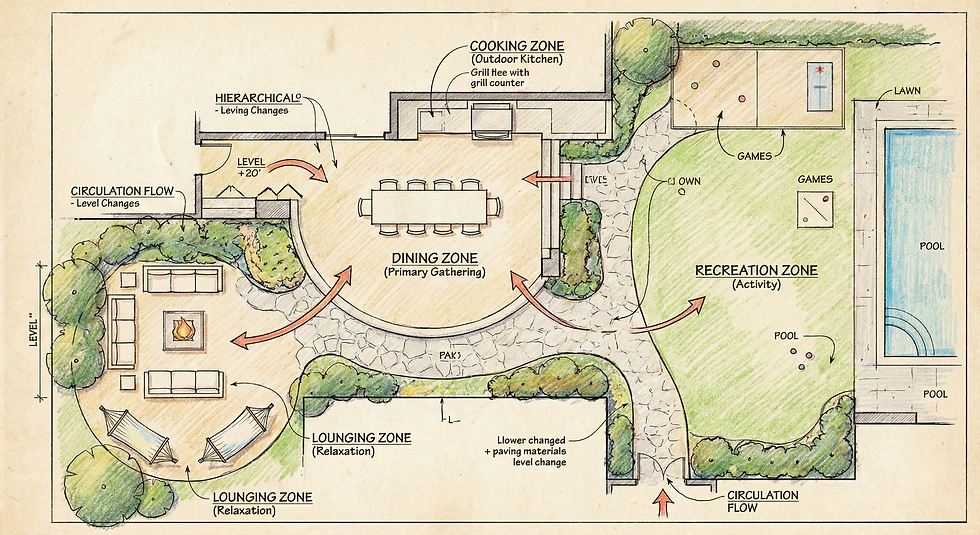
Begin with primary and secondary use patterns. If a space must serve both daily family meals and weekend entertaining, establish a core dining zone dimensioned for typical use, with adjacent areas that can accommodate overflow seating or flexible furniture arrangements. Define these zones through subtle grade changes, material shifts, or planting edges rather than fixed barriers, allowing the space to expand or contract based on need.
Consider temporal patterns. Morning coffee zones benefit from eastern exposure; evening social areas require western orientation with shade strategies. Children's play areas need sightlines from adult supervision zones but separation from fragile planting or dining furniture.
Furniture systems should support transformation: modular seating that reconfigures for different group sizes, tables that extend or separate, storage for cushions and accessories. The design must anticipate how users will adapt the space for various functions without requiring significant effort.
Edge conditions matter critically. Partial enclosures—low walls, raised planters, furniture placement—create sub-zones without full division. These edges provide acoustic dampening, visual separation, and microclimate variation while maintaining overall spatial flow.
Planting as Spatial Architecture
Vegetation functions as architectural material when deployed with structural intent. Plants establish vertical planes, overhead canopies, and ground-plane textures that define space as effectively as built elements—with the added benefits of seasonal change, microclimate modification, and ecological performance.

Layered planting creates depth and spatial complexity. Groundcovers and low perennials (six to eighteen inches) establish visual base planes and reinforce circulation paths. Mid-height shrubs (three to five feet) function as partial walls, screening service areas or creating sub-zones while maintaining air flow. Canopy trees provide overhead enclosure, shade, and cooling through evapotranspiration.
This layering must be designed with the same precision as building sections. A dining terrace requires overhead shade but needs adequate clearance below tree canopies—typically eight feet minimum for comfortable vertical circulation and air movement. Screening hedges should reach their effective height within two to three growing seasons, requiring selection of species with predictable growth rates and appropriate mature dimensions.
Microclimate engineering through planting addresses comfort parameters. Deciduous canopy trees provide summer shade while allowing winter solar gain. Dense evergreen hedges buffer prevailing winds, creating protected zones that extend usability into shoulder seasons. Strategic planting can reduce ambient temperature by five to ten degrees through shade and evaporative cooling, fundamentally altering thermal comfort.
Technical & Engineering Integration
Outdoor living spaces present significant technical challenges requiring coordination across multiple systems. Structural considerations include load-bearing capacity for pavers, decking, and furniture; drainage systems to manage surface water and protect adjacent building foundations; and utility routing for lighting, irrigation, and outdoor cooking equipment.
Material selection must balance aesthetic intent with durability and maintenance requirements. Porcelain pavers offer continuity with interior tile but require proper bedding and jointing. Wood decking provides warmth but needs moisture management and periodic refinishing. Poured-in-place concrete allows seamless surfaces but requires control joints and may show weathering.
Lighting design extends architectural illumination concepts outdoors. Pathway lighting ensures safe circulation; accent lighting highlights key landscape features; ambient lighting creates social atmosphere. All systems require weather-rated fixtures, proper electrical load calculations, and maintenance access.
Drainage engineering cannot be an afterthought. Positive drainage away from building foundations, properly sized collection systems, and permeable paving strategies prevent both immediate water intrusion and long-term structural damage. These systems must integrate with architectural grading while maintaining accessible, level program areas.
Social Use, Atmosphere, and Comfort
Outdoor spaces that successfully support social activities address human comfort parameters beyond basic shelter. Acoustic design matters: hard surfaces create noise that disrupts conversation, while strategic planting and textile elements provide sound absorption. Seating arrangements influence social dynamics—linear benches discourage interaction, while clustered furniture at conversational distances (five to eight feet between seats) facilitates engagement.

Evening functionality requires layered lighting that creates ambience without glare. Indirect uplighting on trees and walls provides soft illumination; low-level pathway lighting ensures safe movement; focused task lighting supports dining or cooking activities. Dimmable systems allow users to adjust atmosphere for different occasions.
Thermal comfort extends usability. Radiant heaters, fire features, or enclosed microclimates enable use during cooler months. Conversely, shade structures, misting systems, and strategic air movement through landscape design make spaces habitable during hot periods. The goal is maximizing the annual window of comfortable occupancy.
Material selection contributes to perceived warmth and comfort. Natural wood, textured stone, and textile elements create tactile richness; metal and glass introduce contemporary refinement. The palette should respond to regional climate, cultural context, and architectural character while supporting the intended social atmosphere.
Conceptual Case Examples
Courtyard Threshold: A central courtyard connects living areas on three sides through floor-to-ceiling glazing with sliding panels. The courtyard floor uses the same large-format porcelain tile as interior spaces, maintaining visual continuity. A mature Japanese maple provides dappled shade, while low boxwood hedges define the perimeter without blocking sightlines. Built-in bench seating integrated into one wall creates casual lounging without freestanding furniture.

Flexible Family Zone: A rear yard incorporates three distinct but connected areas: a covered dining terrace adjacent to the kitchen, an open lawn for active play, and a planted edge with casual seating. The terrace uses a timber pergola structure with retractable shade fabric; the lawn area remains unenclosed; the planted edge uses tiered retaining walls with integrated bench seating and layered perennials and shrubs. Each zone serves specific functions while maintaining visual and physical connection.
Planting-Led Sequence: A narrow side yard transforms into usable program through strategic planting. Tall evergreen screening along the property line creates privacy and wind protection. A decomposed granite pathway with permeable jointing provides all-weather circulation. Mid-height ornamental grasses create rhythmic movement and seasonal interest while defining the path edge. Small accent trees overhead provide dappled shade. The result is a functional outdoor room within a constrained footprint, driven entirely by landscape material strategies.
The Future of Outdoor Living
The integration of outdoor living into core architectural program represents a necessary evolution in design practice. As climate patterns shift, living spaces contract, and occupancy expectations change, exterior spaces must function as essential rooms rather than supplemental amenities. This requires treating landscape design with the same technical rigor, programmatic clarity, and spatial sophistication applied to interior architecture.
Success depends on dissolving false distinctions between disciplines. Architects must understand planting as spatial material; landscape architects must engage with building systems and interior planning logic; engineers must extend performance analysis to exterior environments. The resulting spaces become seamless extensions of architectural intent—outdoor rooms that genuinely expand how buildings are inhabited, season after season.


